Variations
Variations in transposon preparation
In addition to the the basic mariner and Tn5 methods discussed earlier, there are other variations on this theme that have developed that we will discuss briefly.
Phage-based transposition in Staphylococcus aureus (2015)
Typically transposons are delivered to recipient cells by conjugation or by transformation. Santiago et al. adapted a phage-based transposition system to enable high efficiency tranposon delivery in S. aureus.
Magic pools (2018)
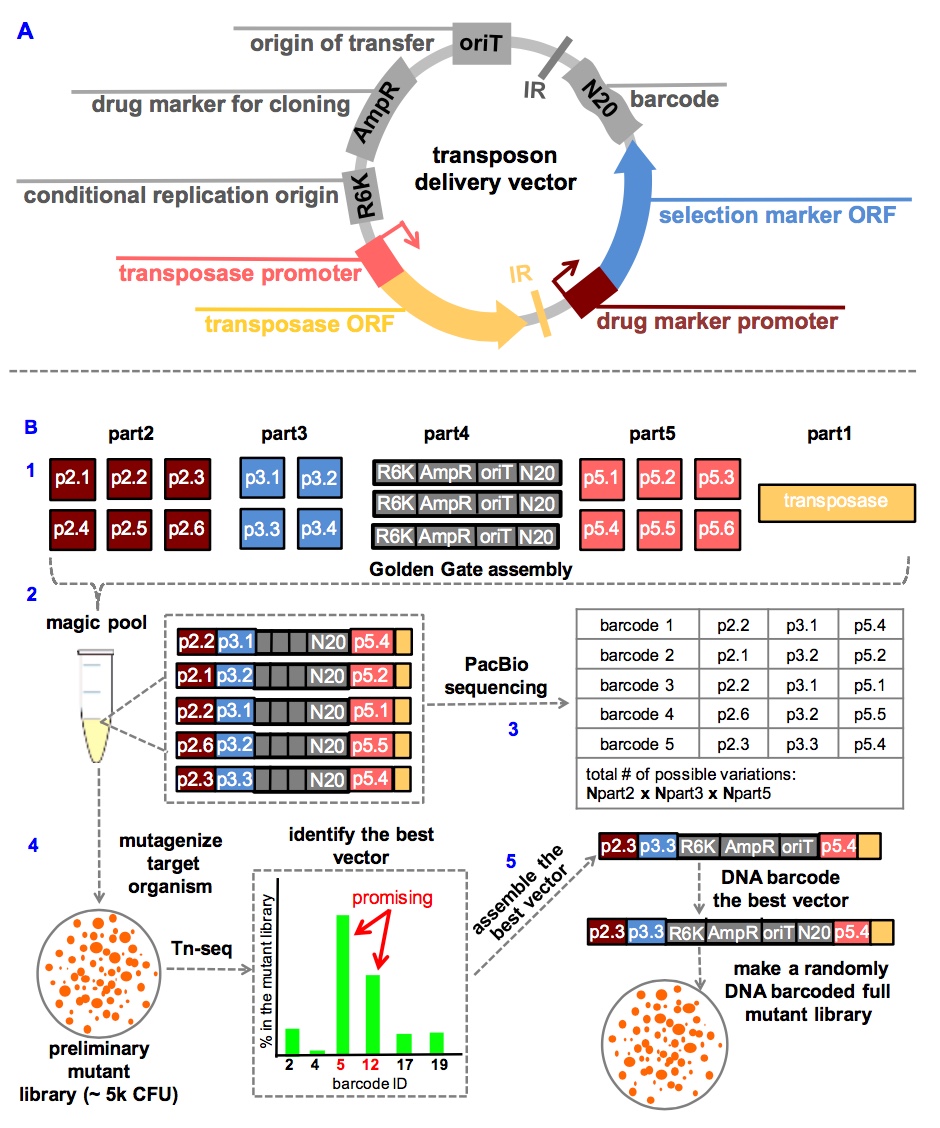
Instead of using rationale design to tweak the antibiotic resistance and promoter, you can select for constructs that work better. This can be tricky as the plasmid is a suicide plasmid, so how do you know which construct gave you the best results? This approach, which they term “magic pools”, seems to be an elegant way to tackle this issue.
Variations in library preparation
Each method has its own quirks. Even similar methods that rely on MmeI digestion have identified different ways to enrich for the chromosome-transposon junctions required for sequencing. Here are additional methods that extend conceptually beyond INSeq/Tn-Seq library preparation.
BarSeq (2015)
In the BarSeq method, elements of STM and Tn-Seq are combined for a powerful combination. The library is constructed with each transposon insertion containing a random section of 20 nucleotides (N20). First, the base library is characterized by typical Tn-Seq methods that identify the transposon insertions and also identify the 20mer for each insertion. In subsequent analyses, a simpler library preparation can be conducted (i.e., amplification and sequencing of the 20mer barcodes) to characterize library dynamics.

Arrayed mutant libraries
Goodman et al. (2009)
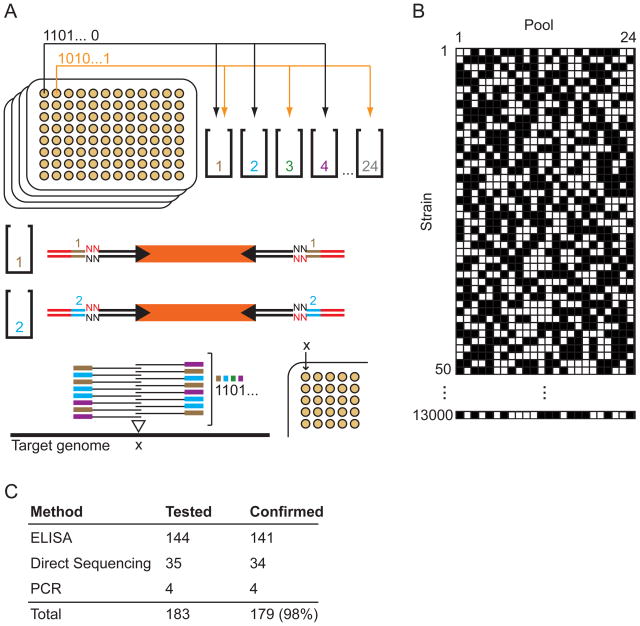
Typically the transposon libraries from INSeq/Tn-Seq approaches have all of the mutants pooled together. However, for many applications in molecular biology it is very useful to have access to individual mutants. Goodman et al. devised an ingenious method to accomplish this. Mutants are first arrayed into 96-well microplates. Each mutant is then placed into a specific subset of 24 pools, and those pools are then analyzed by INSeq. The occurrence of a mutant in specific pools uniquely identifies its location in the original library. The only limitation of the method is that arraying the mutants into the pools requires a dedicated epMotion robot to ensure that mutants are faithfully placed in their assigned pools.
Knockout Sodoku (2016)
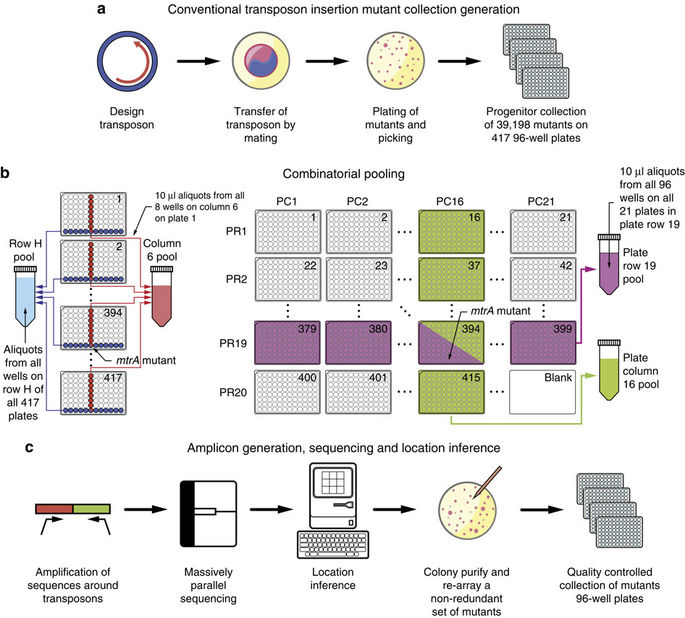
A similar combinatorial pooling approach was adapted to be conducted without a detailed robotic algorithm by Baym et al. in an approach they called “knockout sodoku”. Samples are pooled across plates, rows, and columns. The authors used a 96-well multichannel pipet to pool small volumes from the original plates in a specified fashion.