Transposon selection
We are focusing on the MmeI-based INSeq method, so the key feature will be using a transposon that includes MmeI restriction recognition sites oriented correctly at the ends of each transposon. Any transposon that fulfills this function will work. Goodman & Gordon (and independently, van Opijnen & Camilli) recognized that the MmeI type IIs restriction enzyme recognizes a site that is similar to the terminal repeat of mariner (Himar) type transposases. Mutation of a single base pair in the tranpsoson end enables recognition by MmeI. However, MmeI does not cleave at this sequence. Instead, MmeI cleaves 20 bp away, enabling capture of adjacent chromosomal sequence.

The pSAM base transposon was described by Goodman et al. 2009.
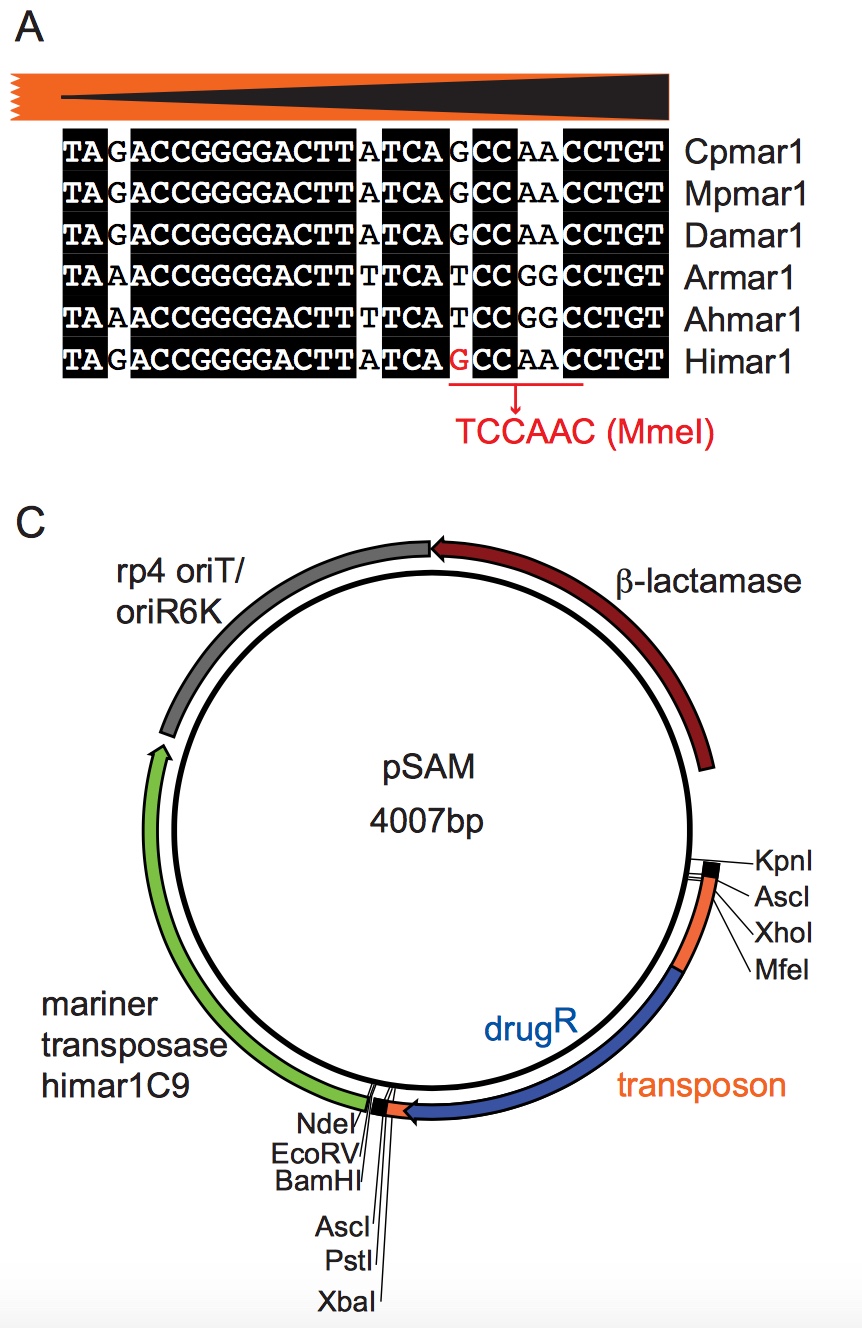
pMarVF1 was derived from pSAM and described in Brooks et al. 2014. pMarVF1 will soon be available at Addgene, and can be further modified as needed for other species and strains.
To illustrate the key changes needed to adapt it to a new organism, here we will describe the changes needed to convert Bacteroides thetaiotaomicron pSAM to Vibrio fischeri pMarVF1:
- The drug resistance cassette was replaced by a cassette that was known to function in V. fischeri.
- The approximately 300 bp promoter for the himar transposase was replaced by promoter from V. fischeri.
As long as the recipient strain is receptive to oriT-based conjugation from E. coli, then these modifications are likely to be sufficient to adapt the system to a new organism.
Cloning a new antibiotic-resistance cassette
Any antibiotic-resistance cassette (with promoter) can be cloned into the XhoI-XbaI fragment within the transposon in pMarVF1. Distal to the XbaI site are transcriptional terminators; so pointing the cassette toward XbaI (i.e., the 3’ end of the resistance gene(s) at the XbaI end of the fragment) will result in a transposon that is likely to be polar, and may be bidirectionally polar.
Once the antibiotic cassette functions in the organism, different candidate promoters can be tested/screened/selected.
Cloning a new transposase promoter
A strong promoter from the species of interest (approximately 300 bp upstream of the ORF) can be cloned into the BamHI-NdeI fragment in pMarVF1. The NdeI side is proximal to the himar open reading frame.
For B. thetaiotaomicron and V. fischeri the promoter for the rpoD gene was used and worked well. pMarVF1 contains another promoter that was tested and exhibited slightly higher numbers of transconjugants in V. fischeri strain ES114.